Smart Education, Brighter Futures: Digital Learning in 10 Government Schools in Udaipur
- 2026-10-11 04:42:00
- Admin
About the Smart Education, Brighter Futures: Digital Learning in 10 Government Schools in Udaipur
Smart Education, Brighter Futures: Bringing Digital Learning to 10 Government Schools in Udaipur
Kalpita Foundation | Digital Education | NEP 2020 | Udaipur, Rajasthan
What if a classroom could open a window to the entire world, making learning more visual, interactive and accessible for every child?
For a child in a school, a lesson should not be limited to the pages of a textbook or the words written on a blackboard. Learning can be experienced through visuals, stories, animations, interactive activities and the power of technology.
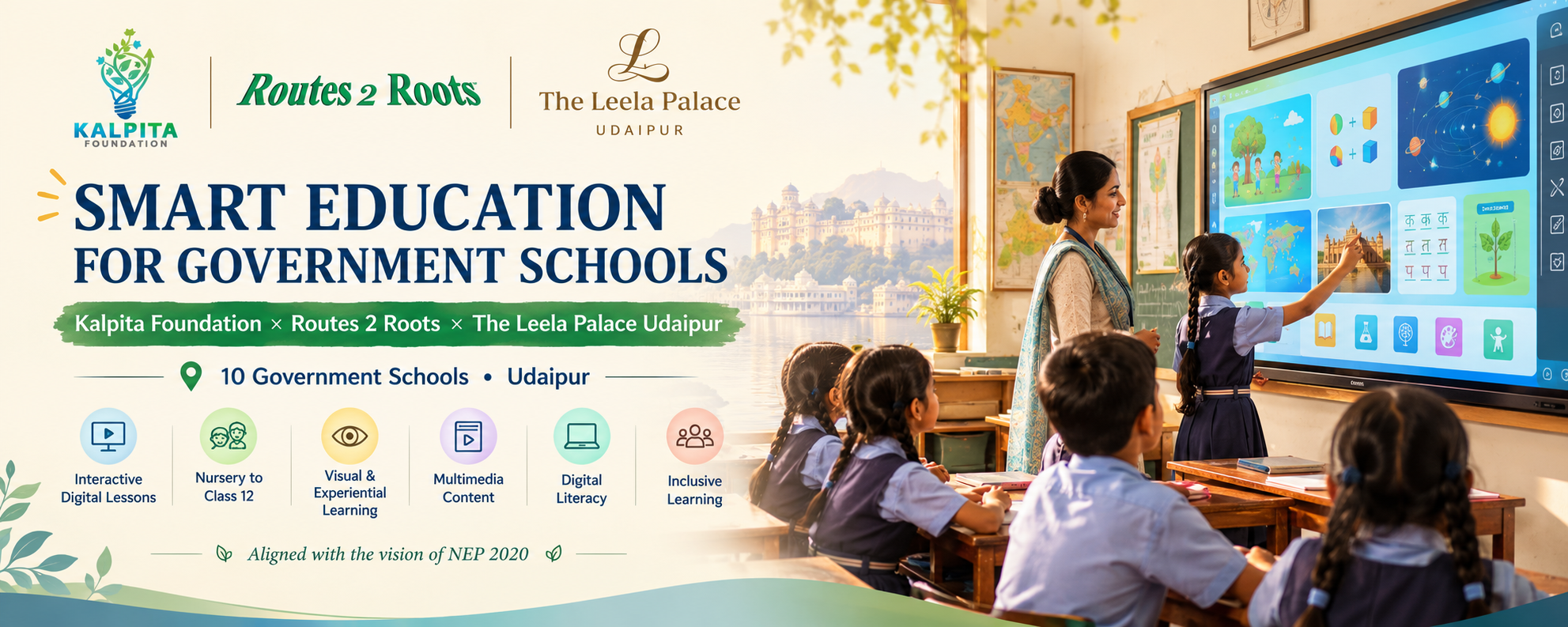
With this belief, Kalpita Foundation, in collaboration with Route2Roots and The Leela Palace, Udaipur, has set up smart panels in 10 government schools in Udaipur, Rajasthan, marking a meaningful step towards digital education and technology-enabled learning.
With educational content covering Nursery to Class 12, the initiative aims to bring new learning opportunities into classrooms and support teachers in making education more engaging, accessible and relevant to the needs of today's learners.
Bringing the World of Digital Learning into Government Schools
A classroom becomes more engaging when children can see, hear, explore and interact with what they are learning.
The smart panels installed across 10 government schools in Udaipur are designed to support this transformation. With lessons spanning from the foundational years of Nursery to the senior secondary classes of Class 12, the panels offer digital learning resources for students at different stages of their educational journey.
From introducing young children to basic concepts through visual learning to helping older students engage with subject-specific lessons, digital education can create opportunities for diverse teaching and learning experiences.
Beyond academic subjects, the smart panels also provide access to extracurricular learning opportunities, including dance, yoga, music, art and theatre. These activities encourage students to explore their creative interests, express themselves, build confidence and discover talents beyond traditional classroom learning.
The panels also offer courses focused on brain development and artificial intelligence (AI), introducing students to cognitive development and emerging technologies. Such learning opportunities can help broaden students' understanding of the world, encourage curiosity and familiarise them with skills and concepts that are becoming increasingly relevant in the digital age.
By bringing academic lessons, creative activities and future-oriented courses together on a common platform, the initiative supports a broader approach to education—one that recognises the importance of intellectual, creative and personal development alongside academic achievement.
The initiative aims to help teachers supplement traditional classroom instruction with multimedia educational resources, making complex concepts easier to demonstrate and lessons more engaging. The objective is not to replace teachers or textbooks, but to empower teachers with technology and give students more ways to understand, explore and learn.
NEP 2020: A Vision for Technology-Enabled Education
The installation of smart panels aligns with the vision of the National Education Policy (NEP) 2020, which recognises the potential of technology in improving the quality, accessibility and effectiveness of education.
The policy's emphasis on technology integration, experiential learning, creativity, skill development and holistic education provides a relevant framework for understanding the value of this initiative.
Here is how the smart panel initiative connects with key objectives of NEP 2020:
1. Technology Integration in Teaching and Learning
NEP 2020 encourages the appropriate integration of technology at all levels of education to improve classroom processes, support teachers and enhance learning experiences.
Smart panels provide a digital interface through which teachers can present lessons, educational videos, illustrations and other learning materials. They can help make classroom instruction more interactive and support the use of technology as a teaching aid.
2. Equitable Access to Quality Education
The policy recognises the digital divide as a challenge and emphasises equitable access to digital learning opportunities, particularly for disadvantaged and underserved communities.
By bringing smart panels into government schools, this initiative seeks to expand access to technology-supported learning environments for students who may otherwise have limited exposure to digital educational resources.
The broader objective is to ensure that a child's access to engaging learning experiences is not determined solely by their socioeconomic background.
3. Experiential, Interactive and Learner-Centric Education
NEP 2020 emphasises conceptual understanding, experiential learning, critical thinking and a shift away from rote memorisation.
Digital educational content can support these approaches through visual demonstrations, animations, activities and interactive explanations. Access to dance, yoga, music, art and theatre further broadens the scope of learning by allowing students to explore creative and experiential activities.
These opportunities can help students connect knowledge with practical experiences, develop confidence and discover new interests.
4. Support for Foundational Literacy and Numeracy
The policy places strong emphasis on Early Childhood Care and Education (ECCE) and foundational literacy and numeracy, recognising the importance of the early years in a child's development.
With content extending from Nursery onwards, the smart panels can support teachers in introducing early learning concepts through age-appropriate visuals, sounds, stories and activities.
This complements the broader NEP vision of making early education engaging, play-based and responsive to children's developmental needs.
5. Multilingual and Inclusive Learning Opportunities
NEP 2020 recognises the importance of multilingual education and recommends the use of the home language, mother tongue or regional language as the medium of instruction, wherever possible, especially in the foundational years.
Digital educational resources can support this objective when content is available in relevant languages and accessible formats.
Smart panels can also provide visual and multimedia learning experiences that may support different learning preferences. The extent of multilingual and accessibility support depends on the content and features available on the installed system.
6. Holistic Development and Future-Ready Skills
NEP 2020 advocates holistic education that goes beyond academic achievement to include creativity, critical thinking, physical well-being, communication and skill development.
The availability of extracurricular content covering dance, yoga, music, art and theatre creates opportunities for students to explore creative expression and develop interests beyond their regular subjects.
Similarly, access to brain development courses and introductory learning in artificial intelligence can expose students to cognitive learning concepts and emerging technologies.
Together, these resources can help broaden the learning experience and encourage students to develop a diverse set of interests and skills alongside their academic education.
7. Strengthening Teachers Through Educational Technology
NEP 2020 recognises that technology must complement effective teaching and that teachers need appropriate training and professional development to use digital tools meaningfully.
Smart panels can assist teachers in presenting lessons, explaining difficult concepts and incorporating multimedia resources into classroom practice. They can also provide additional resources for introducing extracurricular topics and new areas of learning.
The long-term educational value of these installations lies in how effectively teachers integrate the technology into their daily lessons, alongside their own teaching methods and understanding of students' needs.
The policy also encourages the development of digital educational platforms and resources, including DIKSHA, India's national digital infrastructure for school education, and PM e-VIDYA, which promotes multi-mode access to education.
These initiatives reflect the broader national commitment to making quality digital learning resources available to students and educators.
Policy reference: National Education Policy 2020, particularly its provisions on holistic development, technology integration and online and digital education.
One Collaboration. Ten Schools. A World of Learning Possibilities.
The initiative brings together three partners with a shared commitment to expanding educational opportunities.
- Kalpita Foundation works towards inclusive education, youth development and community-led initiatives that create meaningful opportunities for children and young people.
- Route2Roots joins the collaboration in supporting educational and cultural initiatives that connect communities with learning opportunities.
- The Leela Palace, Udaipur is a partner in this effort to bring digital educational infrastructure to government schools.
By establishing smart panels in 10 government schools, the collaboration demonstrates how partnerships between civil society organisations and the private sector can contribute to educational development.
The initiative also reflects the importance of collaborative action in advancing the goals of NEP 2020, where government institutions, communities, non-governmental organisations and other stakeholders can work together to improve access to quality education.
Kalpita Foundation: Making Education More Accessible, Engaging and Meaningful
At Kalpita Foundation, we believe that every child deserves an opportunity to learn, explore and realise their potential.
Our commitment to education extends beyond access to classrooms. We strive to support learning environments that encourage curiosity, creativity, critical thinking and holistic development.
From environmental education and experiential learning to technology-enabled classrooms, our initiatives are guided by the belief that education must evolve with the needs of children and the world around them.
The smart panel initiative in Udaipur is another step towards translating the vision of NEP 2020 into meaningful action. It reflects our commitment to:
- Promoting inclusive and equitable educational opportunities.
- Encouraging the meaningful use of technology in school education.
- Supporting teachers with resources that enrich classroom learning.
- Expanding access to extracurricular and creative learning opportunities.
- Introducing students to emerging fields such as artificial intelligence.
- Creating learning environments that nurture curiosity, confidence and independent thinking.
For us, digital education is not simply about introducing technology into schools. It is about using technology to make learning more accessible, relevant and engaging for every child.
Learn more about Kalpita Foundation and our work towards educational development and sustainable communities at kalpitafoundation.org.
A Future Where Every Classroom Opens New Possibilities
A smart panel is a tool. Its real impact lies in the lessons it helps bring to life, the questions it inspires and the opportunities it creates for students.
For the children in these 10 government schools in Udaipur, this initiative represents an opportunity to engage with digital educational content from the foundational years through Class 12, while also exploring creative activities and learning about emerging technologies.
For teachers, it offers an additional resource to support classroom instruction and introduce diverse learning experiences. For the wider community, it is a reminder that meaningful educational change begins when people come together with a shared purpose.
As these classrooms embrace new ways of teaching and learning, Kalpita Foundation remains committed to working towards a future where quality education is inclusive, technology-enabled and accessible to all.
Because every child deserves a classroom that inspires them to imagine more, discover more and become more.
Together, let's make learning limitless.
Kalpita Foundation | In collaboration with Route2Roots and The Leela Palace, Udaipur.