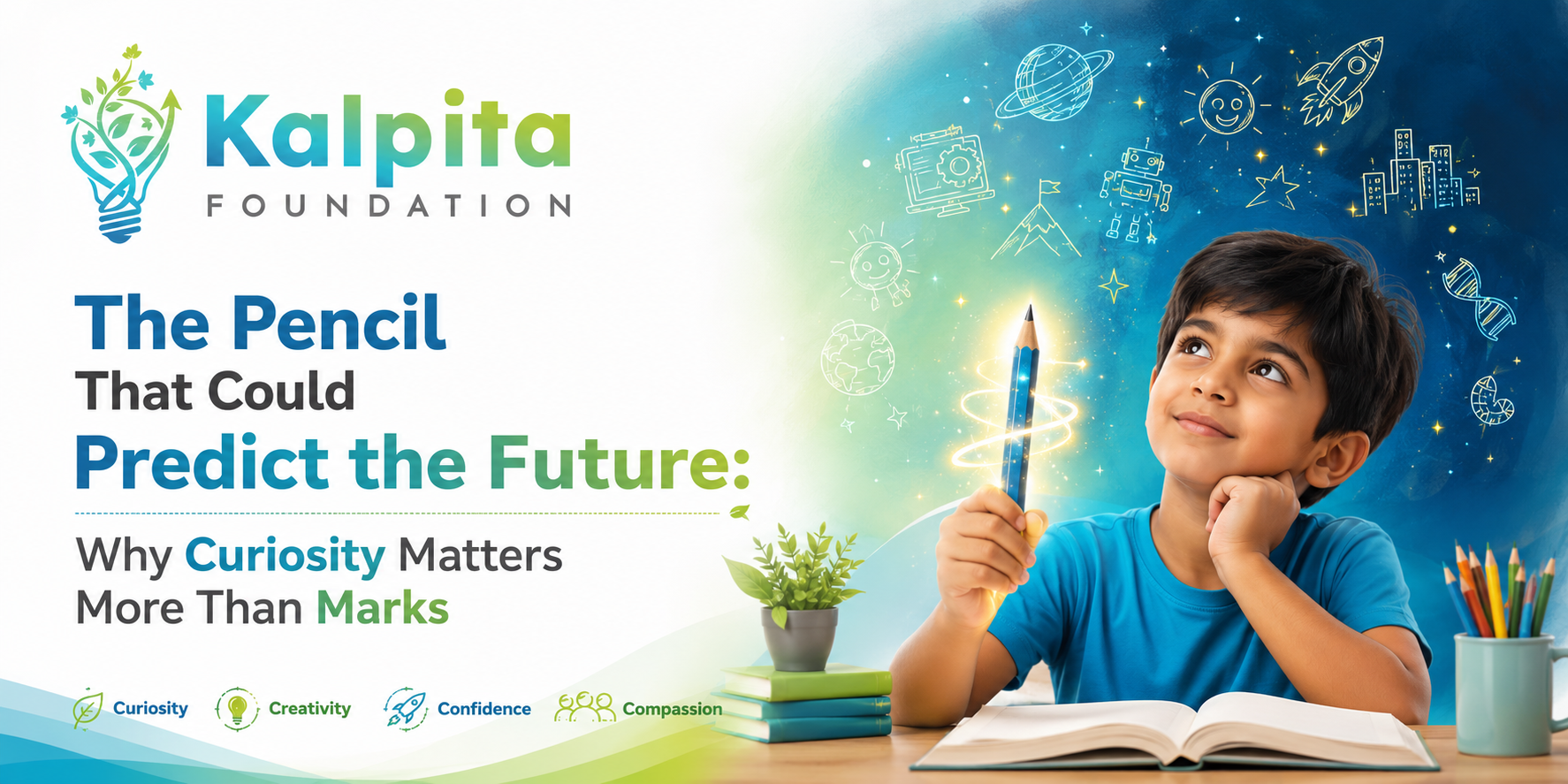
The Pencil That Could Predict the Future: Why Curiosity Matters More Than Marks
- 2026-06-12 10:44:40
- Admin
About the The Pencil That Could Predict the Future: Why Curiosity Matters More Than Marks
Imagine walking into a classroom in the year 1900.
A teacher asks students to memorise facts, repeat information, and follow instructions. Now imagine stepping into a modern classroom more than a hundred years later.
The blackboard may have become a smart screen. Books may have become tablets. Yet one question remains surprisingly relevant:
Are we preparing children for exams, or are we preparing them for life?
One of the most fascinating facts about childhood learning is that young children ask nearly 300 questions a day. Why is the sky blue? How do birds fly? What happens inside a seed before it becomes a tree?
Curiosity is a child's natural superpower.
Yet as children grow older, many begin asking fewer questions and focusing more on finding the "right answer." Somewhere between report cards and competitive exams, curiosity often takes a back seat.
At Kalpita Foundation, we believe that curiosity is not a distraction from learning—it is the foundation of meaningful learning.
The Hidden Cost of Only Chasing Marks
Academic achievement is important. However, the future will demand much more than textbook knowledge.
Tomorrow's leaders, innovators, scientists, artists, and changemakers will need creativity, adaptability, emotional intelligence, problem-solving abilities, and confidence.
These qualities cannot be developed through memorisation alone.
A child who scores well in mathematics may still struggle with decision-making. A student who excels in science may not yet understand their strengths, interests, or future aspirations.
This is why modern education is gradually shifting from information-based learning to potential-based learning.
The goal is no longer simply to ask, "What did the child score?"
The more important question is, "What can this child become?"
Discovering Potential Before Choosing a Path
Every child possesses unique strengths waiting to be discovered.
Some children are natural leaders. Some are creative thinkers. Others excel in observation, communication, innovation, or empathy.
However, identifying these strengths requires more than academic grades.
Through scientific tools such as Psychometric Assessments, educators and parents can gain deeper insights into a child's interests, aptitude, personality, and learning preferences.
When children understand themselves better, they make more informed academic and career choices. Instead of following trends, they begin following purpose.
This process becomes even more impactful when combined with personalised Career Counselling that helps students explore possibilities aligned with their natural abilities and aspirations.
Learning Beyond Four Walls
Think back to your most memorable childhood lesson.
Was it something written in a notebook?
Or was it an experience?
Research consistently shows that people remember experiences far longer than lectures.
This is why experiential learning has become one of the most powerful educational approaches worldwide.
When students participate in Outdoor Learning experiences, leadership activities, nature explorations, and collaborative challenges, they develop resilience, teamwork, communication skills, and confidence.
A trekking trail can teach leadership.
A campfire discussion can teach empathy.
A team challenge can teach problem-solving.
These lessons often stay with children long after they forget textbook chapters.
Experiences transform information into understanding.
Why Creativity Will Be the Currency of the Future
The future belongs to individuals who can imagine, innovate, and adapt.
Technology can process information faster than humans. Artificial Intelligence can generate answers in seconds.
What remains uniquely human is creativity.
Creativity is not limited to art, music, or storytelling. It is the ability to see possibilities where others see obstacles.
This is why initiatives such as Kala Vriksha and other Curiosity Expeditions are designed to nurture imagination, exploration, creative expression, and innovation.
When children are encouraged to create rather than simply consume, they develop confidence in their ideas and courage in their thinking.
These experiences help transform young learners into future creators.
Building Future-Ready Learners
Future readiness is often misunderstood.
Many people assume it means learning coding, technology, or digital tools.
While these skills are valuable, true future readiness is much broader.
Future-ready learners possess:
- Critical thinking abilities
- Emotional resilience
- Communication skills
- Ethical decision-making
- Digital awareness
- Leadership qualities
- Lifelong learning habits
Developing these capabilities requires a balanced ecosystem that combines Future Skills education, experiential learning, wellbeing initiatives, mentorship, and self-discovery.
The objective is not simply preparing students for jobs that exist today.
It is preparing them for opportunities that may not even exist yet.
The Future Begins With Curiosity
A famous story tells of a young boy who constantly asked questions about how things worked. His teachers often considered him distracting because he was always curious.
That boy grew up to become Albert Einstein.
History repeatedly reminds us that curiosity is the starting point of discovery.
Every inventor, scientist, entrepreneur, artist, and leader began their journey with a question.
What if?
Why not?
How does this work?
At Kalpita Foundation, we believe every child deserves the opportunity to ask those questions, explore those possibilities, and discover their unique path.
Because education is not about filling minds with information.
It is about igniting minds with possibility.
And when curiosity meets opportunity, extraordinary futures begin to take shape.